01RoofingConcept
Ridgeline Roofing
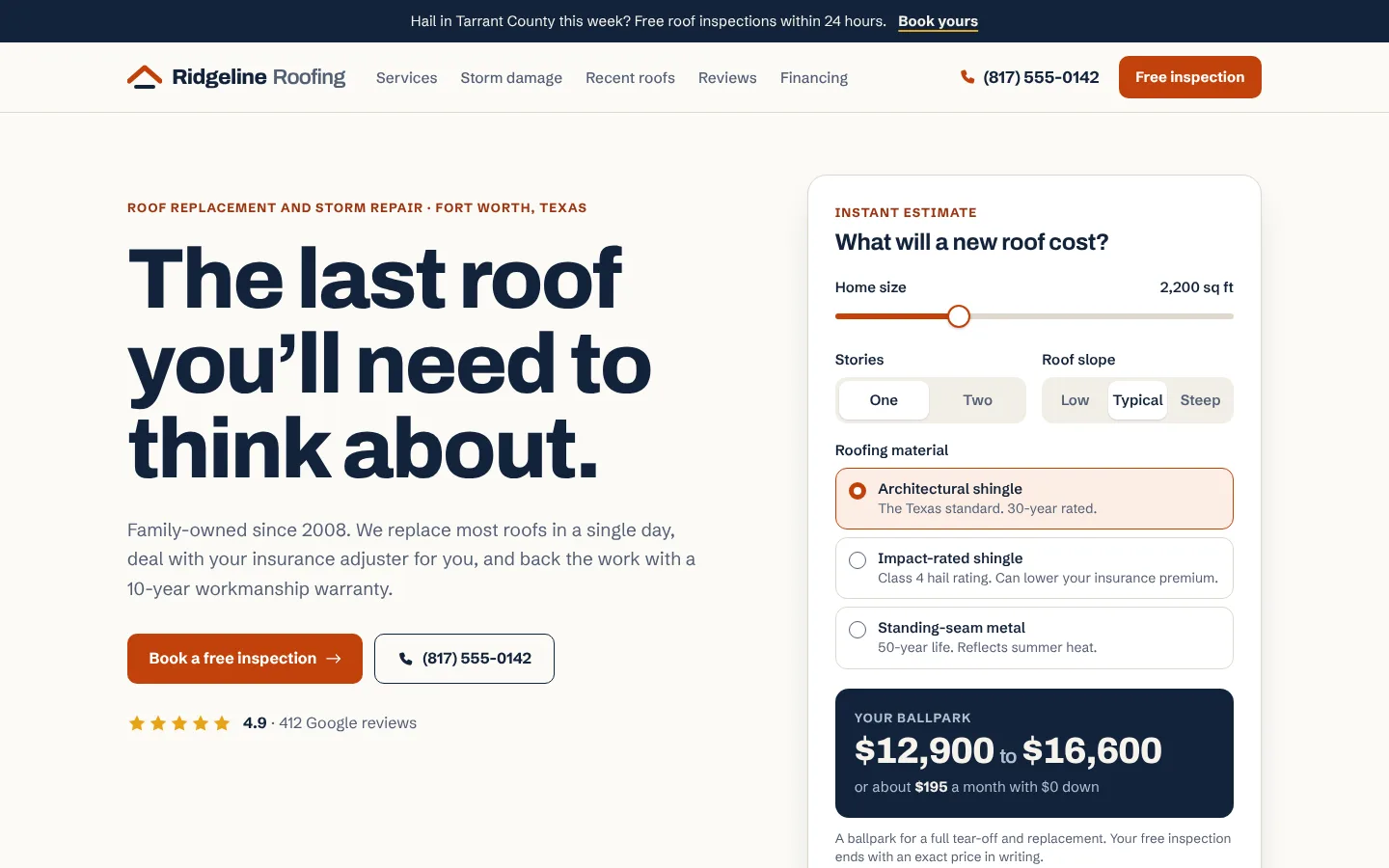
A residential roofer’s site built for the week after a hailstorm: a ballpark price in ten seconds, a plain account of how an insurance claim works, and a free inspection one tap away.
- Sector
- Roofing
- Scope
- Strategy, design, build
- Stack
- Next.js · TypeScript · Tailwind
- Year
- 2026
Overview
What we built, and why.
After a hailstorm, a homeowner has door-knockers on the porch and three questions: is my roof damaged, what will it cost, and who can I trust. Most roofing sites answer none of them. They show a stock photo, a phone number and a form that asks for everything.
Ridgeline’s site answers in that order. The estimator gives a price range before anyone asks for a name, the storm section explains the claim in four steps, and every screen ends at the same action: a free inspection.
Project facts
- Brief
- Self-initiated concept
- Deliverables
- One-page site, price estimator, inspection form
- Audience
- Homeowners after storm damage
- Build
- Hand-coded, no page builder
The brief
The brief we set.
Ridgeline is a family-owned roofer in Fort Worth, Texas, with seventeen years of work and a few hundred roofs a year. Around two thirds of its jobs are insurance claims after hail; the rest are aging roofs paid for with financing.
Its competitors after a storm are out-of-state crews who knock on doors. The site has to do what they cannot: show a local license, real neighborhoods, written warranties and honest prices.
Who it is for
- Primary
- Homeowners with possible hail damage
- Secondary
- Owners of roofs past 20 years old
- The decision
- Book a free inspection
Goals & challenges
What it had to do.
Goals
Give a price before asking for a name
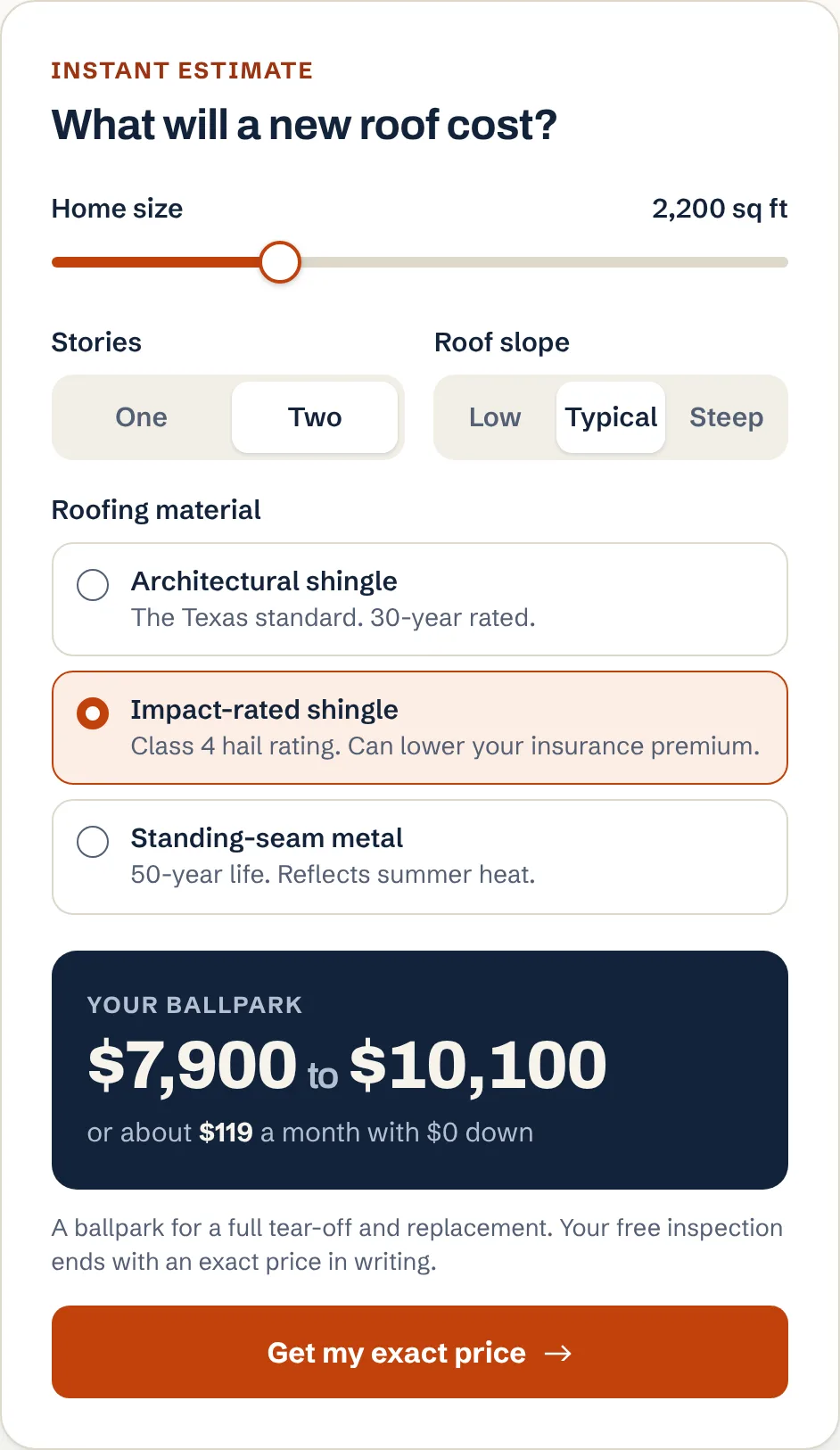
Home size, stories, slope and material produce a range and a monthly payment on the page, with nothing to sign up for.
Make the insurance claim understandable
Four steps, each with a time and a plain description of who does what, including the part where the roofer says there is no claim.
Be one tap from a phone call
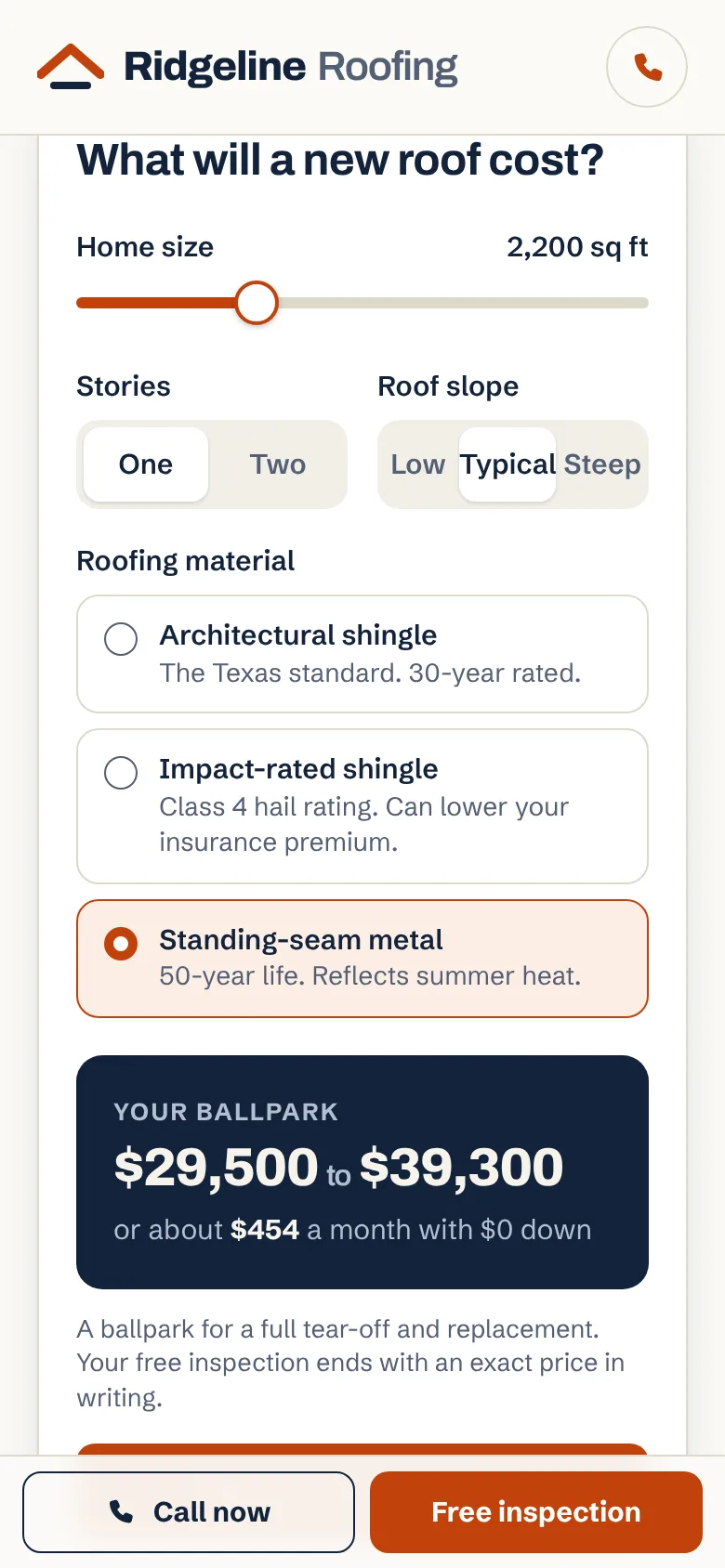
The number is in the header, the hero and the inspection section, and phones get a fixed call bar on every screen.
Challenges
An estimate that stays honest
The estimator rounds to the nearest hundred, shows a range and says it is a ballpark. The exact price comes in writing after the inspection, and the page says so beside the number.
Custom controls that still work for everyone
The slider, the segmented choices and the material cards are native range and radio inputs underneath, so they work from a keyboard and are announced properly by screen readers.
Design direction
How it looks, and why.
Plain-spoken and sturdy, like the lettering on a work truck. Warm white, deep navy and one burnt orange that is kept for things you press. The hero carries a line drawing of rooftops with one roof picked out in orange.
Palette
Chalk
#FBFAF6
Background
Sand
#F2EFE7
Panels
Navy
#13233A
Text and dark sections
Slate
#535F74
Secondary text
Ember
#C2410C
Actions
Type
Display
Archivo 800
clamp(44px, 7.2vw, 88px) / 1
The last roof you’ll need to think about.
Body
Schibsted Grotesk 400
17px / 1.6
We replace most roofs in a single day.
Interface
Schibsted Grotesk 700
16px
Book a free inspection
Key decisions
Orange means “do this”
The one strong color is reserved for buttons, the selected material and the phone icon. Nothing decorative uses it.
Specifics over superlatives
License number, warranty length, neighborhoods, days on site. A homeowner comparing three roofers can check every claim.
Honesty as the sales pitch
The copy says a third of inspections find no claim and that waiving a deductible is fraud. That is what separates a local roofer from a storm chaser.
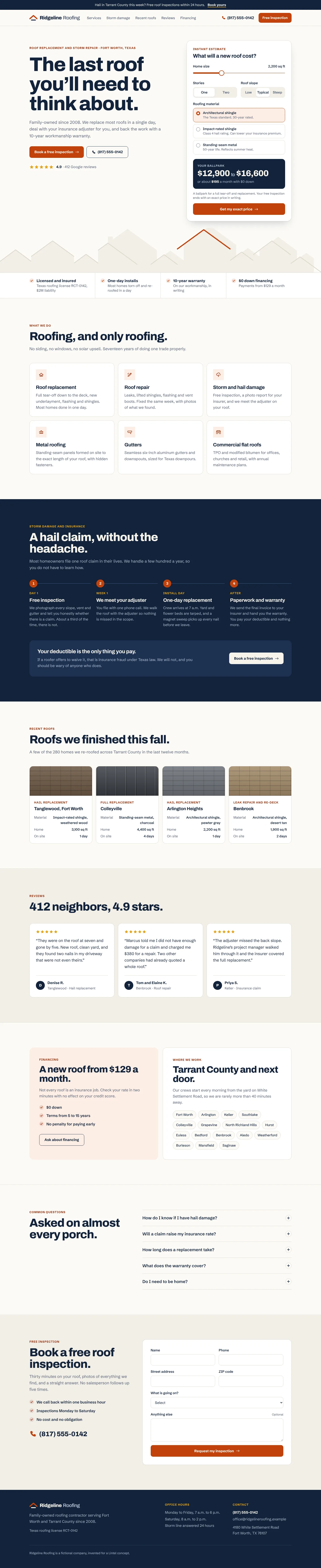
Screens
The build, page by page.
Captured from the live concept, not mocked up.

Key features
What it does.
Instant price estimator
Home size, stories, roof slope and material give a price range and a monthly payment as you move the controls. Everything is calculated in the browser.
Estimator: two stories, impact-rated shingle
Insurance claim in four steps
Inspection, adjuster meeting, install day and paperwork, each with a time and what the homeowner has to do, which is very little.
Inspection form that validates
Five fields, checked as a real form would be: a ten-digit phone number and a five-digit ZIP. On the concept it confirms without sending anything.
Call bar on phones
Most storm traffic is on a phone, so Call and Free inspection stay fixed at the foot of every screen.
The estimator on a phone
Results
Measured, not claimed.
Measured on the live concept with Lighthouse (mobile preset), median of three runs.
Measured on the live concept ·
- Performance
- 99 out of 100
- Accessibility
- 100 out of 100
- Best Practices
- 100 out of 100
- SEO
- 100 out of 100
SEO leaves out Lighthouse’s crawlability check. Concept sites are deliberately set to noindex, so no one mistakes them for real businesses.
- Page weight
- 276 KB
- JavaScript
- 147 KB
- Requests
- 23
- The estimator and the inspection form are the only interactive components; beyond the framework runtime, the rest of the page is static HTML.
- No photographs and no third-party scripts, so the page stays light on a phone connection.
Next
Want this standard for a real business?
Every Lintel project starts with a free recorded audit of your current site. No obligation, and it’s yours to keep.